General dental care
The best and cheapest way to keep your teeth healthy is, first and foremost, good oral hygiene.
How often should you have a check-up?
How often you should have a check-up varies a great deal from person to person, and after every check-up we always recommend when your next one should be.
It is important to have regular check-ups, as any dental problems can be spotted while they are small. That makes them both easier and cheaper to treat.

Two types of check-up
There are two types of check-up: a status examination and a focused examination.
Those who come once a year, or less often, only have the status examination. This is the patient with no dental disease, good oral hygiene and no medication. If just one of these 3 factors applies, a focused check-up is recommended every 3, 4 or 6 months.
Here we follow up on what we found at the status examination: cavities, gum inflammation, tartar, wear, headaches or disorders of the mucous membranes.
Why our patients choose us
Your needs at the centre
We focus on dental treatment based on your individual needs.
All treatments in one place
From check-ups to implants, orthodontics and oral surgery. You only need to go to one place.
Peace of mind above all
We explain the treatment clearly, so you know exactly what is going to happen.
Emergency help the same day
We always do our best to find an appointment the same day, whether you are a new or existing patient.
Green, yellow and red
The Danish Health Authority has decided that, as a patient, you are risk-assessed in a green, yellow or red category.
Green
As a green patient you should have a check-up every 12 to 24 months. There is only a subsidy once a year for both check-up and cleaning. You are welcome to come more often, but the state only subsidises it once a year.
Yellow
Yellow patients have active disease in the teeth, gums or mouth, while your dentist assesses that you, together with the dentist, can help improve your oral health. The interval varies from every 3 to 8 months.
Red
Patients in the red category have active disease in the teeth, gums or mouth and are also medically compromised. They are seen every 3 to 6 months.
The dental hygienist specialises in preventive treatment
A dental hygienist is trained to prevent cavities and gum disease, whereas the dentist steps in once the damage is done. Should treatment be needed, our hygienist or dentist will draw up a treatment plan together with you.
There may be several solutions to your problems, each with pros and cons, which is why we listen to your wishes and needs. We go through the possible solutions so you are better placed to make the right decision for you.
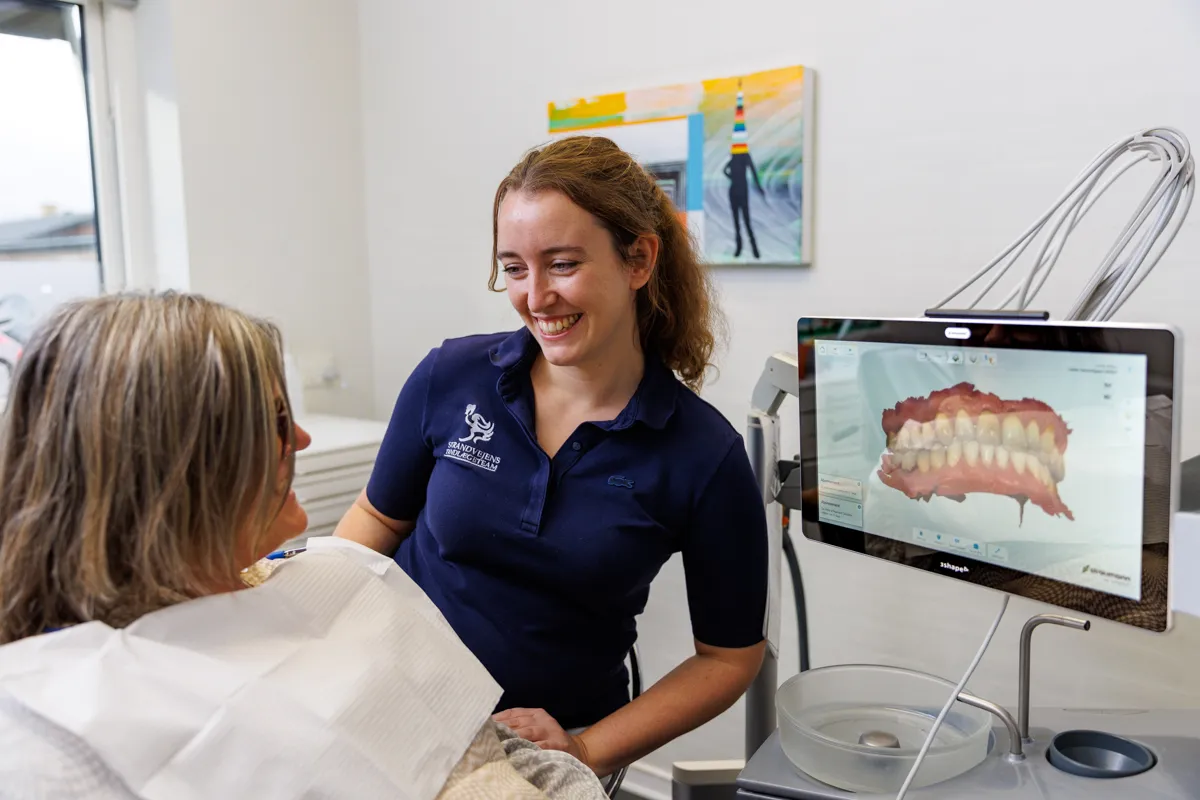
At a check-up, individual preventive treatment may be relevant, X-rays if we see reason for them, and a cleaning where we remove tartar and clean the teeth of stains and plaque.
Shall we take a look?
Call us, or write to us through the form, and we will find a time that suits you.
Other treatments
We can offer you all kinds of treatments, so you only need to go to one place.